 MUL
Small programs.
Checked twice.
MUL is a statically typed language built for code that AI agents write and read. Every program goes through one verified SSA IR, then runs in a reference interpreter or compiles to native code with Cranelift, and the tests hold both to the same answer.
// Hello, world (RFC-010): `print` is an `io` operation, so `main` is `io`.
// `mul run` prints the line and exits with the value of `main`, here 0.
module demo

pub fn main() -> i32 io {
    print("Hello, world!")
    return 0
}
$ mul run examples/hello.mul; echo "exit code $?"
Hello, world!
exit code 0
Build from source
Needs rustup and a C driver for linking; the toolchain is pinned.
$ make build
$ ./target/release/mul run examples/hello.mul
What the compiler guarantees today
Each snippet below was compiled and run by mul when this page was built; the output is copied from that run.
-
Arithmetic is checked
An i32 that overflows stops the program with MUL-R002 instead of wrapping to a wrong value, in both backends.
module demo

fn double(n: i32) -> i32 {
    return n * 2
}

pub fn main() -> i32 {
    return double(2000000000)
}
$ mul run --print-result overflow.mul overflow.mul:4:12: error[MUL-R002]: i32 overflow in `mul` [byte 51] | return n * 2 | ^^^^^ $ mul run --backend cranelift --print-result overflow.mul overflow.mul:4:12: error[MUL-R002]: i32 overflow in `mul` [byte 51] | return n * 2 | ^^^^^ -
Effects are part of the signature
A function that prints is io. A pure function cannot call it, so a signature tells you what a call may do.
module demo

fn greet() -> i32 io {
    print("hi")
    return 0
}

fn quiet() -> i32 {
    return greet()
}

pub fn main() -> i32 io {
    return quiet()
}
$ mul check effects.mul effects.mul:9:12: error[MUL-T013]: a `pure` function cannot call the `io` function `greet` [byte 99] | return greet() | ^^^^^^^ -
No implicit conversions
bool is not a number and i32 is not a bool. A mismatch is a compile error with a stable code and a pointer to the span.
module demo

pub fn main() -> i32 {
    let ready = true
    return ready + 1
}
$ mul check types.mul types.mul:5:12: error[MUL-T012]: type mismatch: expected `i32`, found `bool` [byte 68] | return ready + 1 | ^^^^^ -
Interpreter and native code agree
The reference interpreter and Cranelift run the same verified IR, and the tests fail on any difference between them.
module demo

fn fib(n: i32) -> i32 {
    if n < 2 {
        return n
    }
    return fib(n - 1) + fib(n - 2)
}

pub fn main() -> i32 {
    return fib(20)
}
$ mul run --print-result backends.mul 6765 $ mul run --backend cranelift --print-result backends.mul 6765
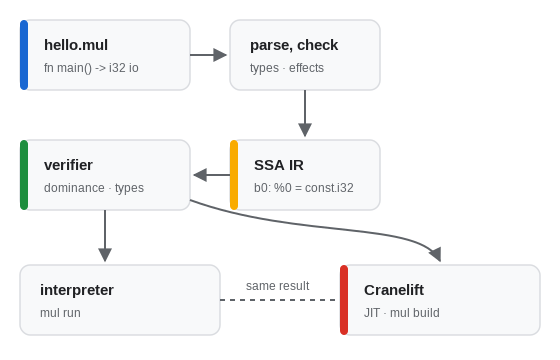
One IR, two backends
The IR is the source of truth. Nothing runs before the verifier accepts it.
- The parser and the type checker resolve names, types and effects, and report errors with a stable
MUL-*code. - The program is lowered to SSA form with basic blocks and block parameters;
mul irprints it. Every IR node maps back to a range of the MUL source, so a run-time error points to the line that caused it. - The verifier checks dominance, types and effects of that IR.
- The interpreter and Cranelift run the same IR. Golden, conformance and documentation tests run in both and fail on any difference.
Where to start
-
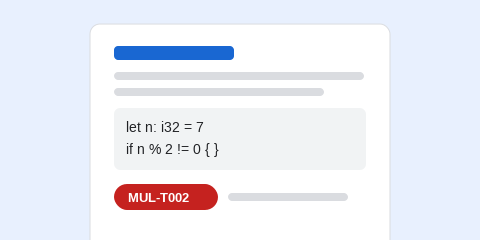
Language reference
Syntax, types, effects and every error code with its fix. Each code block is compiled and run by the test suite.
-
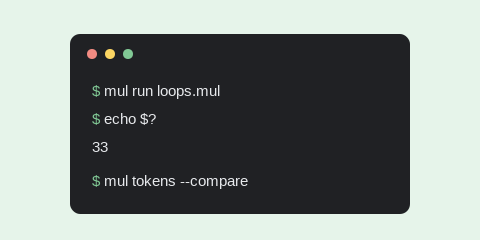
Examples
The programs from
examples/with their verified IR and output, and token counts against Go, PHP, C and Rust. -
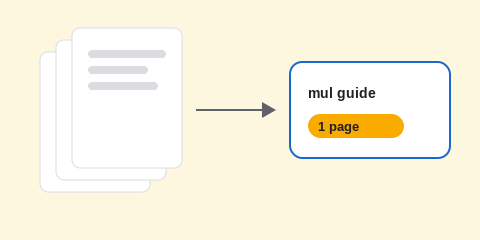
Compact guide
The whole current language on one page, sized for a model's prompt.
mul guideprints the same text.
From the blog
-
Identity and persistence
Stable symbol ids and hashes, the .mulb file with an integrity check, runtime errors that point to the MUL source line, and fuzzing of the readers.
-
Welcome to MUL
What MUL is, what compiles today, why every result is checked twice, and what comes next: identity, Go patch mode and an API for agents.